
An Angry Woman Is Not a Goddess. She's Sometimes Just a Wounded Girl
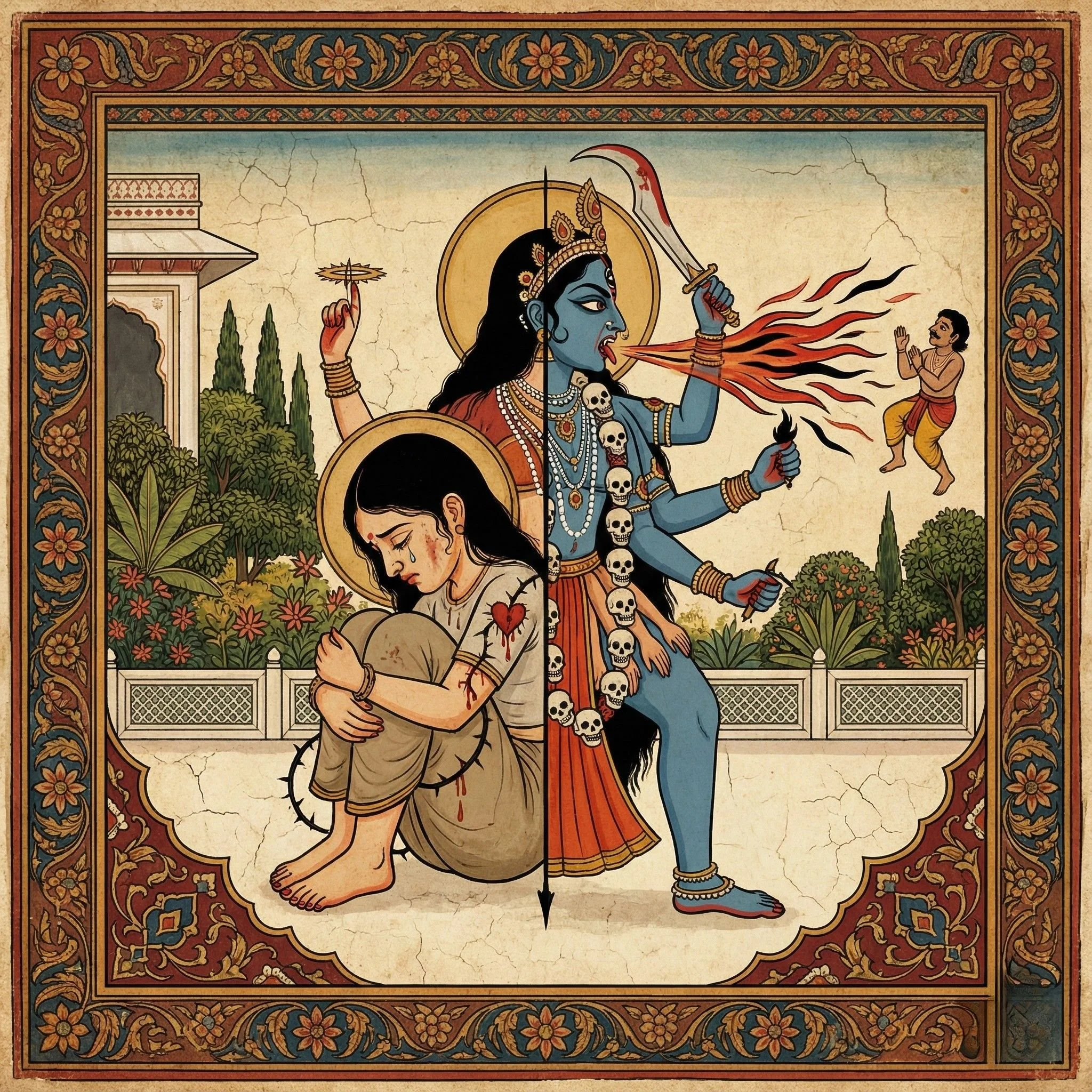
One of the most damaging mistakes in the New Age world, generally, and in Neo-Tantra specifically, is treating women as if they were GODDESSES.
Men have always worshipped women. After all, there's no man who wasn't born from a woman's womb, not even Jesus. Every man nursed and saw in his mother the great Goddess of the universe in the early stage of his life. So the image of woman as Goddess is embedded deep in our being, even after we grew up and realized mom isn't exactly the great Goddess. As a man matures, the Goddess image is stored in his subconscious, waiting for moments of grace when he can see through his beloved, the ultimate mother—the great Goddess of the universe.
The ability to shift consciousness and see divine revelation through the person standing before us is indeed one of the deepest practices in many mystic traditions. When Jesus's disciples suddenly saw him as divine revelation, on the peak of Mount Tabor, conversing with Moses and Elijah, it was considered a foundational event, and the mountain has been called by Christians "the Mount of Transfiguration":
"He was transfigured before them, and his face shone like the sun, and his clothes became white as light. And behold, there appeared to them Moses and Elijah talking with him" (Gospel according to Matthew).
Through Christian terminology, the term "Transfiguration" penetrated Western translations of tantric texts. Today, there are Neo-Tantra schools that conduct “Transfiguration Ceremonies,” in which participants' consciousness is invited to shift to a deeper frequency than usual
This brainwave frequency allows one to see the person before them not just as a limited human creature, but as divine revelation shimmering through flesh.
Yet somehow, perhaps because of the heavy monotheistic background of the West, you'll hear in the spoken language of the New Age world fewer references to men as gods and more references to women as goddesses. Fewer men will declare something weird like "I am a god" (unless they're some crazy guru), but many women will claim "I am a goddess" — especially if they see themselves as sexy enough in the mirror, wearing organic cotton clothes from Bali.
Despite the abundance of biblical imagery available to us of God with smoke rising from his nostrils, furious and raging, wanting to destroy the entire world—when a man gets angry and pounds his fists on the table, he won't get the treatment of "Oh! That's God raging here!"
Yet how many times have you heard a woman justify her rage toward her partner as the rage of the Goddess?
How many times have you heard explanations that feminine anger is the holy wrath of Kali, the dark Hindu goddess, or at least a powerful manifestation of Lilith?
Therefore, if you, the human man by her side, didn't receive her destructive rage with love, gratitude, and full presence, it's a clear sign you don't know how to receive the energy of the Goddess! And obviously something's wrong with you. Especially if you need external validation that you're indeed “a tantric man”.

So I want to say this clearly: No person has the right to dump their rage on another, whether they're a man, woman, or any other gender. No person should be the emotional punching bag for another's unconscious rage discharge.
When a woman erupts in rage at her partner, it is not Kali and not Lilith who's raging within her. It's the wounded, hurting inner child who hasn't yet learned to regulate herself. Treating that angry child as a dark and raging goddess will not contribute to the healing of her wounds. This is narcissistic inflation of the wounded personality, and an abuse of spiritual jargon that creates a classic spiritual bypass.
The transfiguration of the human into the divine is a foundational experience of consciousness expansion that occurs in moments of spontaneous revelation (yes, sex can sometimes be such a moment, too) or within the framework of ceremonies, meditations, and deep initiations.
The mystical recognition of a woman as someone through whom one can sometimes see the Goddess was not meant to serve as a tantric excuse for throwing a tantrum. About situations like these, I believe the Ten Commandments say: "Thou shalt not take the name of thy God\ess in vain."
And trust me, I by no means want to dismiss the pain of the inner child. On the contrary. I believe she has good reasons to be hurting. Childhood traumas, big or small, are common to all of us. The father is the girl's first love — a love destined to eventually disappoint her. During early adolescence, she usually experiences confusion, distance, and rejection from this masculine figure. This complex relationship leaves scars and unresolved issues in many girls' psyches (Many good psychology books have been written about this).
The projection of the father figure onto every potential lover, and the wish that he'll fully be there for her, is part of being a human woman. Just as the projection of the mother figure onto every beloved woman is part of the complexity of being a human man who was born from a vulva and nursed from nipples.
The problem begins when, instead of touching the pain, we rationalize the rage with spiritual excuses. Instead of wondering what and why disproportionate rage is erupting in me, what ancient wounds it's sitting on, and how I should approach this angry inner child, "the dark Goddess" is pulled from the spiritual jargon storage and serves as justification for verbal and emotional violence. A kind of claim that "this rage is the Goddess's rage. Therefore, it's sacred, and therefore I'm right!"
Many men collaborate with this trend of deifying unprocessed feminine rage. Especially if they're afraid of not being considered spiritual enough, or losing sexual access to all those amazing GODDESSES. The angry child gets almost automatic backup from her sisters. Men who want to be considered spiritual and conscious enough nod in agreement, too, and the whole community applauds her.
In my eyes, there's no honor in this, not for the woman and certainly not for the Goddess.



True honor for a person is recognizing their complex humanity. I, and you, and all of us are deeply human. And that means we're full of wounds and traumas, we have quite a few blind spots, and it's pretty rare that we see reality as it is, especially when we're emotionally activated. Honor for a person is seeing their psychological wounds with compassion as a very human matter, and treating them with appropriate tools (and there are many good methods and tools to do this today).
Tantra, like any worthy mystical tradition, demands of its practitioners spiritual discipline, emotional maturity, and the integration of shadow materials. Using elevated language to justify dumping unprocessed emotions on others is not walking the tantric path, but rather a flattening of spiritual depth for fairly narcissistic self-justification, which is a part of the modern spiritual capitalism phenomenon.
"The Goddess dwells in woman's body. One who does not honor woman cannot worship the Goddess" (Kularnava Tantra).
"He who did not desire woman is like a donkey, and less. The reason being, that from the carnal one must distinguish the divine" (Rabbi Isaac of Acre, 13th-century Kabbalist)
To honor a woman, in my view, is to see her in her humanity, not to flatter her as if she were the embodiment of the Goddess. When she uses the person with her as if he were a vessel meant to contain her unprocessed emotional intensities, she is no different from a violent man. He's not a god, and she's not a goddess.
To honor women and the Goddess is to allow ourselves, men and women alike, to properly treat our psychological wounds, until no behavior from the other triggers us, and if it does trigger us, that we're at least aware of it in real-time, and know how to emotionally regulate ourselves without erupting at the other.
Only then, there's a possibility that in moments of grace, when consciousness expands, we can see the divine through the person before us, and tears of gratitude will flow like rivers down our cheeks.
"If a person merited to see her in her true form, he would live forever. She yearns for the hour when they will know her as she truly is, for then all her powers will be validated" (Jacob Frank, "Words of the Master," 18th century)
Sacred Anger
But the truth is that every time we're angry, even if the anger is an unconscious mess, beneath the layers of these unprocessed emotions, there exists a sacred spark of divine truth.
Except this truth is less about the person who triggered our anger, and more about ourselves. About a certain truth we need to wake up to in order to live a life of truth.
Anger always points us to the places where we've betrayed ourselves. Our essence. Our divinity.
When we dump anger in its raw form on another person's head, we're pouring gold ore into sewage. What a waste.
Anger teaches us that something about the way things are running in our lives is no longer right for us, and maybe hasn't been right for a long time, but we've been repressing it. Anger pushes us to take action that will change the situation from here on out. Anger asks us to stop betraying ourselves.
This has nothing to do with gender. Man, woman, or anything in between—we all betray ourselves, and we need anger's energy (coming from the liver) to return to our life's true path.
Processing emotion is not repression. On the contrary. When I'm willing to do the work with my anger, I recognize there's a divine spark in the anger that arose in me, even if it stems from old childhood wounds. This anger is meant for us as a warning sign, so we'll change the way we conduct our lives. Maybe the anger is asking us to set boundaries where we didn't set them before. Maybe the anger is asking us from now on to stand for our values without fear. Anger might be pointing to a relationship that must change, or even end. Anger is a great teacher. It's a very important biological mechanism that the great Goddess of evolution planted within our system.
In conclusion
To honor a woman — is to see her in her full humanity.
To honor the Goddess — is not to take her name in vain. Not to parade around in Kali's skull necklace when what we really need is a teddy bear necklace, or a pacifier.
To honor anger—is not to pour it like psychic sewage on the person before us, but to do the work that will help us discover the gold hidden in it—the sparks of the raging Goddess who guards the temples of truth in our hearts from our own lack of awareness (this kind of work is part of what we teach in the Black Butterfly initiation workshops).
And the person who triggered our anger?—If we learn the lesson that anger wants to teach us, maybe in some time we'll thank them too. Thank them in our hearts for serving as a deafening alarm, waking us from our slumber so we could return to our life's true path. Then we'll learn to honor them too.
——
Ohad Pele, 2026